
There was a scramble in the skies Sunday tied to President Trump's visit to the Chicago area.
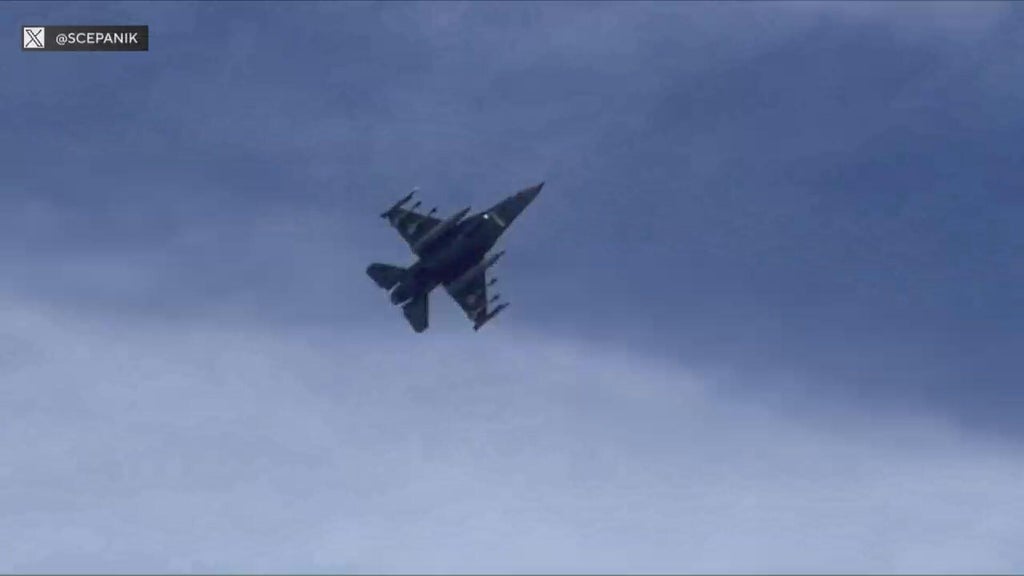
F-16 fighter jets intercepted multiple planes that violated flight restrictions the Federal Aviation Administration put in place due to the president's visit. Witnesses caught videos of the jets in the skies, apparently armed and ready to handle any threat.
The North American Aerospace Defense Command, or NORAD, said 15 general aviation aircraft, a category that includes private planes and helicopters, entered airspace that was supposed to be restricted while the president was in town.
Fighter jets performed physical intercepts to redirect 10 pilots. In two instances, the jets fired flares to get the pilots' attention and forced them to change course.
NORAD said the flares may have been visible to the public, but always burn out quickly and completely and pose no danger to anyone on the ground.
NORAD said all the situations were safely resolved, and no one was hurt.
Nearly 1,800 flights were delayed at O'Hare International Airport on Sunday. It was unclear late Sunday whether those delays were because of flight restrictions or a nor'easter hitting the East Coast.
President Trump on Sunday paid a visit to the Medinah Country Club outside of Chicago for the last day of the Presidents Cup golf tournament, serving as the honorary chairman. His presence in the Chicagoland area brought crowds of supporters and protesters.
Robert Werderich, vice president of operations for the Illinois Aviation Academy at the DuPage Airport, said while the temporary flight restriction in the area around Medinah Country Club was well communicated ahead of the president's visit, it was extended past the original time of 3:45 p.m., catching some pilots by surprise.
"The TFR was extended, and therefore, they got in trouble," Werderich said. "So, unfortunately, then there's this notification of extension, and it has to go through the process to get published."
Werderich said, when flying within a mile of a TFR, pilots should call the flight service station or air traffic control.
"To have an intercept, and to know, oh my gosh, I screwed up – not only did I screw up, but I got the military involved – has to be a traumatic experience for those pilots," Werderich said.
Paramotor pilot Curtis Haley said, despite double-checking before takeoff on Sunday, he was unaware of the TFR extension and technically violated it by flying. He was not intercepted, but realized it later that night.
He recorded video of another plane being intercepted in Plainfield.
"I know I'm small, I'm tiny on the radar, I know I serve no threat, but obviously, due to national security, I … you know, they probably think otherwise," he said.
CBS News Chicago traffic expert Kris Habermehl has been flying planes since 1978. He said checking for temporary flight restrictions is something that should be on every pilot's pre-flight checklist, and violations are not taken lightly.
"Mistakes are not looked upon as mistakes. That is a grievous error in judgement. So that being the case, you're going to be talking to the FAA, the Secret Service, local law enforcement, and it's going to start right at the airport at which you land," Habermehl said. "I have never actually seen this many incursions."
The FAA is investigating the pilots who violated the TFR to determine what level of enforcement is necessary. Penalties can range from additional training to fines or even jail time.


